
You’ve found a good opportunity to grow your business whether it’s buying discounted stock, upgrading equipment, or securing a commercial space. You start exploring business loan, but there’s one problem: your recent tax returns may not be lodged, or business write-offs make your profit look lower on paper than your actual cash flow.
Traditional banks usually require full tax returns, balance sheets and profit and loss statements before approving finance. Without these documents, getting a standard business loan can become difficult.
This is where understanding the difference between Full Doc and Low Doc business loans becomes important. For self-employed business owners, sole traders, startups and growing Australian businesses, choosing the right loan type can make it easier to access funding and keep business plans moving forward.
Why Documentation Matters to Lenders
When a financial institution lends money to an Australian business, their main concern is serviceability—whether your cash flow can comfortably cover loan repayments along with your regular business expenses.
The Core Problem
Business growth does not always match tax deadlines. Tax returns look at past performance, often from months or even years ago. If your business has recently doubled its revenue, your previous financial year’s tax return may not show that growth. Waiting for your accountant to finalise tax lodgments could mean missing an important business opportunity.
How Lenders View Risk and Serviceability
Lenders use financial documents to assess the risk of lending to a business and its ability to repay the loan. Complete and up-to-date financial records give lenders a clearer view of the business’s revenue, profitability, cash flow and existing commitments.
When some documents are unavailable, the application may be considered higher risk. However, this does not always mean an automatic rejection. Depending on the lender, they may accept alternative evidence such as bank statements or BAS, adjust the loan terms, or offer finance at a higher interest rate to reflect the additional risk.
What is a Full Doc Loan?
A Full Doc (Full Documentation) loan is a traditional type of business finance in Australia. It requires complete and verified financial records to show your business income, assets, and ability to repay the loan.
Typical Requirements and Documentation Checklist
When applying for Full Doc business loans in Australia, lenders may ask for:
- Two years of company tax returns and personal tax returns for all directors
- Australian Taxation Office (ATO) Notices of Assessment (NOAs)
- Current Profit & Loss (P&L) statements and balance sheets
- At least 6 months of business bank statements
- Details of existing debts, commercial leases, and director guarantees
These documents help Australian lenders assess the financial position and repayment capacity of your business before approving the loan.
Pros and Cons of Full Doc Financing
- Pros: Full Doc business loans can offer lower interest rates, higher borrowing limits and longer repayment terms. When secured by commercial property, loan terms may extend to 25–30 years, depending on the lender and loan type.
- Cons: Full Doc loans generally involve more paperwork and stricter lending criteria. Approval and settlement may also take longer, ranging from around two weeks to more than a month, depending on the complexity of the application.
What is a Low Doc Business Loan?
A low doc business loan (Low Documentation loan) is a finance option for businesses that may not have two years of completed or lodged tax returns available. Instead of relying mainly on historical financial records, lenders may assess the business using recent trading data, bank statements, BAS and other supporting documents to understand its current financial position.
How Low Documentation Verification Works
Low Doc finance does not mean no paperwork. Lenders still need evidence that the business has sufficient revenue and cash flow to manage loan repayments. The main difference is that they may use current business performance instead of relying heavily on historical tax returns.
Alternative Financial Statements Accepted by Lenders
For a low doc business loan in Australia, a non-bank or specialised lender may assess:
- Business Activity Statements (BAS): Usually the last 4 to 8 quarters of lodged BAS to confirm turnover reported to the ATO.
- Business Bank Statements: Around 6 to 12 months of bank statements showing regular business income and cash flow.
- Accountant’s Declaration: A letter from a qualified accountant confirming estimated turnover and the business’s ability to manage the proposed repayments.
- Active ABN/GST Details: Proof of an active Australian Business Number (ABN) and GST registration, usually held for at least 6 to 12 months.
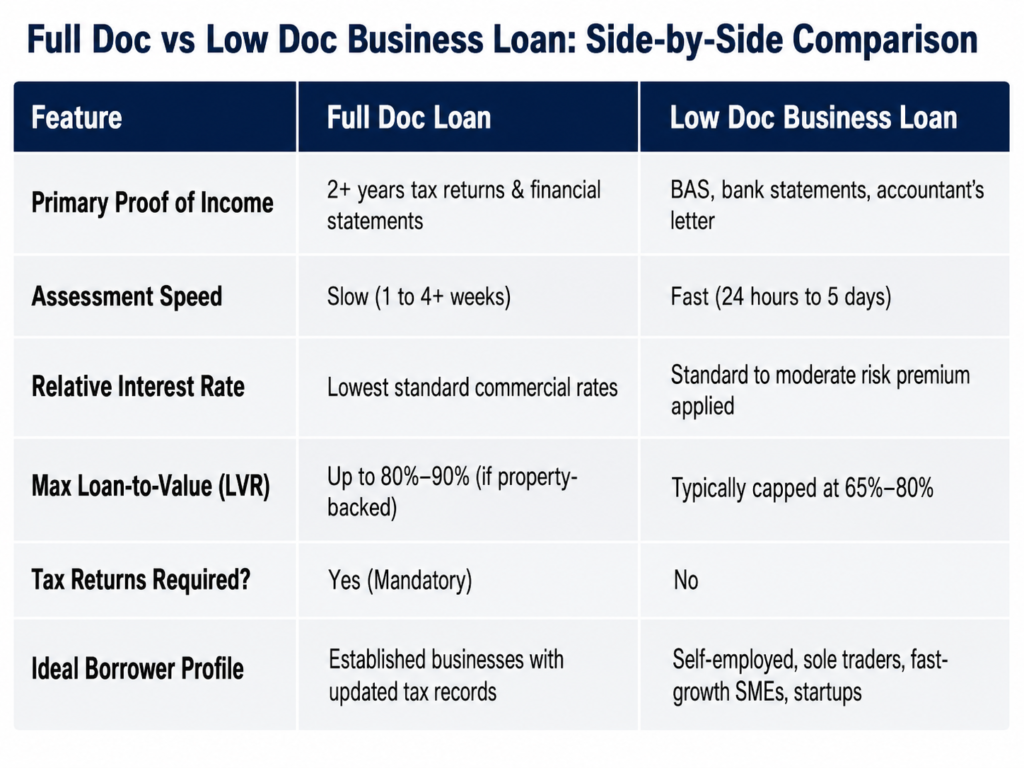
Strategic Analysis: Cost, Speed and Cash Flow Impact
Choosing between these options depends on the business’s priorities, particularly lower borrowing costs versus faster approval and processing.
The Cost vs. Speed Trade-Off
If securing the absolute lowest interest rate is your primary goal, a Full Doc loan remains the preferred choice.
However, speed carries real monetary value. If waiting four weeks for a traditional bank approval costs your business a $100,000 profit margin on an unrepeatable inventory deal, paying a slightly higher interest rate on a low doc business loan that settles in 48 hours is often a logical trade-off.
Common Misconceptions: Low Doc Isn’t ‘Bad Credit’ Lending
A common myth is that low doc facilities are designed for businesses with poor credit.
In reality, documentation type and credit quality are separate factors. A business can have a clean credit file, substantial assets and strong revenue, yet still require a low doc business loan simply because its accountant has not lodged the most recent tax returns.
Cash Flow Impact on Daily Working Capital
While low doc approval is faster, interest rates and fees can be higher, and repayment terms may be shorter depending on whether the debt is secured or unsecured. Model your cash flow projections carefully before signing to ensure that loan repayments fit comfortably within your weekly or monthly operational budget.
- Applying for Full Doc Without Complete Financials: Submitting an incomplete application to a tier-one bank leads to processing delays and unnecessary credit file inquiries.
- Confusing ‘Low Doc’ with ‘No Doc’: True no doc loans (requiring zero proof of turnover) are rare in Australia due to strict responsible lending laws. Expect to provide bank statements or BAS at a minimum.
- Failing to Verify ABN & GST Registration Timelines: Most low doc lenders require an active ABN registered for GST for at least 6 to 12 months. Applying with a brand-new ABN without checking lender criteria often leads to declines.
- Not Planning an Exit Strategy: Many business owners use a low doc business loan to secure fast funding, then refinance into a lower-rate Full Doc facility once their annual tax returns are finalized.
How a Business Loan Broker Can Help Navigate Your Options
Navigating the commercial finance landscape in Australia can be complex. Major banks, regional lenders and specialized non-bank institutions all maintain different eligibility criteria for low doc products.
An experienced business loan broker can assess the business’s cash flow, available documentation and funding needs before matching the application with suitable lenders. Whether the business needs a Low Doc line of credit, commercial asset finance or a long-term business loan, a broker can also help streamline the application process and reduce unnecessary credit enquiries.
A Full Doc loan may suit established businesses with up-to-date financial statements that want access to more traditional lending options. A Low Doc loan may be more suitable when current financials are not readily available but the business can still demonstrate its position through bank statements, BAS or other supporting documents.
The right option depends on the business’s financial position, funding purpose, available documentation and lender criteria.
Xpress Finance helps Australian SMEs compare Full Doc and Low Doc business loan options and structure applications around the most suitable lender and product.
Speak with Xpress Finance for a personalised business loan review →
Frequently Asked Questions (FAQs)
Can startups get a low doc business loan in Australia?
Yes, some non-bank lenders offer low doc business loans to startups, provided the business has traded for at least 3 to 6 months and can demonstrate regular income through business bank statements or BAS filings.
What interest rates apply to low doc business loans?
Interest rates on low doc loans are generally higher than traditional Full Doc bank loans because lenders receive less financial documentation. The actual rate depends on factors such as the business’s credit profile, trading history, loan amount and whether the loan is secured.
Is an accountant's letter required for a low doc business loan?
Not always. Some Australian alternative lenders may assess a low doc business loan using business bank statements or lodged BAS statements without requiring an accountant’s letter.
Do low doc business loan applications affect credit scores?
A low doc loan application does not automatically damage a credit score. However, submitting multiple formal applications to different lenders within a short period can result in several credit enquiries. A business loan broker may help businesses compare suitable options while reducing unnecessary applications.