
Buying a business in Australia can be a practical alternative to starting from scratch. For many aspiring entrepreneurs, especially within South Asian and Indian communities, side hustles, family businesses, franchises and established businesses are becoming realistic paths to ownership.
So, what does buying an existing business offer? What risks should buyers consider, and how should the purchase be funded? Looking at both options can help buyers decide whether business ownership through acquisition is right for them.
An established trading business may already have customers, revenue, staff, suppliers and working systems. This head start can reduce some of the uncertainty involved in launching from scratch while giving the new owner a platform they can improve and grow.
However, buying a business is not a shortcut to guaranteed success. It still requires careful due diligence, suitable business funding and a clear plan for the first year after settlement.
Xpress Finance Founder and Managing Director, Sidd Bahree recently discussed these issues on SBS Hindi. The conversation covered industry knowledge, finance options and practical cash flow planning before making an acquisition.
Why More People Are Considering Business Ownership
Traditionally, a stable job has offered Indian and South Asian migrants something business ownership cannot always guarantee: a predictable income. However, that sense of security is changing. Rising living costs, workplace uncertainty and rapid advances in AI have encouraged more people to look for additional income streams.
At the same time, the growth of the gig economy has made side businesses, part-time ventures and franchise ownership more accessible. As a result, many people are now building income outside their regular jobs.
This shift is making business ownership feel more accessible. However, the choice between starting and buying still depends on the buyer’s goals, experience and financial position.
Buying a Business vs. Starting One: The Trade-Offs
Starting a business from scratch gives you complete control. You can shape the brand, products and customer experience around your own vision.
For a new business, the biggest challenge is often finding customers who are willing to pay. A startup must build trust, create demand and develop a steady flow of revenue.
Buying an existing business may offer two important advantages:
- Proof of concept — The product or service has already found a place in the market.
- An existing customer base — You gain access to paying customers, which is often one of the hardest parts of building a business.
These advantages matter because many new businesses struggle to prove demand or attract enough customers. In the SBS Hindi discussion, Sidd Bahree notes that around 20% of businesses fail in their first year, while about 60% fail within three years.
An established business may reduce some of these early-stage risks. It may also provide evidence of how money moves through the operation.
For example, financial statements, tax returns, BAS records and bank activity can show the business’s revenue, expenses and cash flow. This information may also help a lender assess whether the business can support repayments under a business acquisition loan.
For the buyer, existing cash flow can make planning more realistic. Instead of relying only on future projections, they can compare their forecasts with the business’s actual performance.
However, past sales do not guarantee future success. Buyers still need to understand whether customers are loyal to the business or mainly to the current owner. They should also check whether revenue is recurring, seasonal or dependent on a small number of clients.
This is one reason buying a business may support a smarter wealth strategy. The buyer is not purchasing only an idea. They may be acquiring an income-producing operation that can be improved and expanded over time.
Which Industries Make Sense for First-Time Buyers?
For first-time buyers, the best industry is often one they already understand.
This is sometimes called a “circle of competence.” It means having practical knowledge of how the industry works, including customer expectations, staffing, suppliers, operating costs and market demand.
For example, someone with experience in transport may be better placed to assess a logistics business than a hospitality venue. Similarly, a person who has managed a professional services firm may understand the risks of buying a client-based business more easily than someone entering the sector for the first time.
Relevant experience does not remove every risk. However, it can help buyers ask better questions, identify problems earlier and make more informed decisions. It may also support a finance application by showing that the buyer has the skills needed to operate the business.
The industry itself is only one part of the assessment. Buyers should also check whether the business depends heavily on one customer, one supplier, a key employee or the personal relationships of the current owner.
These factors can affect both the value of the business and the way a lender assesses the transaction. Therefore, the goal is not simply to find a business that looks successful. It is to understand what creates its value and whether that value is likely to continue after settlement.
For buyers without strong industry experience, a franchise may be worth considering. A franchise usually provides an established brand, tested systems, training and operating support.
As Sidd Bahree explains, a franchise can work like a “turnkey operation.” The main systems are already in place, so the buyer is not required to build the business model from the beginning.
How Business Acquisition Finance in Australia Works
Business acquisition finance in Australia can be structured in different ways. Some buyers use a mix of personal capital and lending, while others may use equity in property or other assets to support the purchase.
In the SBS Hindi discussion, Sidd Bahree explained that some buyers may contribute around half of the required capital and borrow the remaining amount. However, this is not a fixed rule. The right structure depends on the buyer’s financial position, available assets, risk profile and the type of business being purchased.
The amount of capital required can also vary widely:
- Some smaller service-based franchises may start from around $25,000 to $30,000.
- Food franchises usually require a larger investment.
- Some micro-funding programs may provide around $10,000 to $15,000 for smaller ventures.
- Larger business acquisitions generally require a higher contribution and stronger financial reserves.
However, buyers should not focus only on the purchase price. They also need enough working capital to operate the business after settlement.
Expenses such as wages, rent, supplier payments, stock, insurance, marketing and repairs will continue from the first day. Therefore, using every available dollar to complete the purchase may place the business under immediate pressure.
The right finance structure should cover both the acquisition and the ongoing operating costs. A business finance broker can help assess the buyer’s contribution, possible business acquisition loans and working capital requirements.
Ultimately, there is no single loan structure that suits every business purchase. The right approach will depend on the purchase price, business performance, available security, buyer experience and the business’s ability to meet repayments.
First Steps for Anyone Serious About Buying a Business
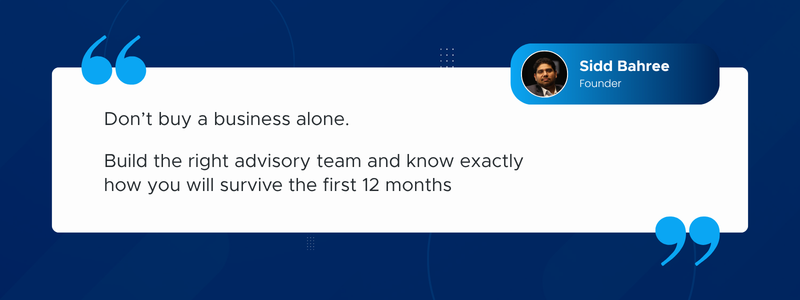
- Anyone serious about buying a business should focus on two essentials:
- Build the right advisory team. A business purchase involves financial, legal and commercial decisions. Buyers should involve a finance broker, an accountant and a lawyer early in the process. Each adviser looks at the opportunity from a different angle. The accountant reviews financial performance and tests the assumptions behind the asking price. The lawyer examines the sale agreement, lease, employee obligations and contractual risks. Meanwhile, the finance broker assesses lender requirements, business acquisition loans and the most suitable funding structure. The right advisers do more than simply agree with the buyer. They ask questions, understand the buyer’s financial position and identify possible risks before recommending the next step.
- Prepare a realistic cash flow plan. Before buying the business, estimate the income and expenses for the first 12 months. This can show whether the business can meet its operating costs and loan repayments. The forecast should include realistic assumptions for sales, wages, rent, utilities, suppliers, insurance, tax obligations and owner drawings. It should also allow for transition costs and a possible drop in sales after the current owner leaves. A practical cash flow forecast helps answer an important question: can the business remain stable if the first few months are more difficult than expected? A conservative plan may not look as attractive as the seller’s best-case forecast. However, it gives the buyer a clearer view of the capital required and the risks involved. The strongest advisers take time to understand both the business and the buyer’s risk profile. Likewise, a useful cash flow plan should be practical rather than overly optimistic
A Business Acquisition Can Become a Platform for Growth
The long-term value of a business acquisition often depends on what the new owner does after settlement.
An established business may already have customers, staff, suppliers and working systems. This gives the buyer a base they can improve over time.
For example, the new owner may introduce better technology, improve internal processes, expand the product range or reach new customers. They may also open another location once the business is stable.
These changes can support stronger cash flow and increase the value of the business. However, growth should be planned carefully.
Future expansion may require business expansion loans or other forms of business growth finance. Before taking on more debt, the owner should review the business’s performance, cash flow and ability to manage additional repayments.
A smarter wealth strategy is not simply to buy a business and wait for its value to increase. It is to choose carefully, protect cash flow and create value through informed ownership.
Five Questions to Answer Before Making an Offer
- Do I understand how this business attracts customers and makes money?
- Will its cash flow support operating costs, loan repayments and my income needs?
- How dependent is the business on the current owner, one client or one key employee?
- How much working capital will remain available after the purchase?
- Have an accountant, lawyer and business finance broker reviewed the opportunity?
Buying a business in Australia may suit someone who wants an established customer base, operating history and a clearer starting point than a new venture can offer. It may not suit someone who wants complete creative freedom, has limited working capital or is entering an industry they do not understand.
The right decision depends on the quality of the business, the finance structure and the buyer’s ability to operate and improve it. An established business can reduce some startup uncertainty, but only careful preparation can turn that head start into sustainable value.
Hear the Full SBS Hindi Discussion
This article is based on Siddharth Bahree’s conversation with SBS Hindi. In the podcast, he discusses business acquisition, funding options, industry knowledge and the importance of practical cash flow planning.
Listen to the full discussion on SBS Hindi for more insights on buying and financing an existing business in Australia.
For more practical insights on business finance and growth, connect with Sidd Bahree on LinkedIn.
Planning to Buy a Business?
Xpress Finance can help buyers explore business acquisition loans, working capital and other business funding options. If you are planning an acquisition or comparing business loans in Melbourne, speak with a business finance broker before committing to the purchase.
Frequently Asked Questions
Does industry experience matter when buying a business?
Relevant experience can help a buyer assess the opportunity and manage the business effectively. It may also support the finance application by showing that the buyer understands the industry and its risks.
When should a business finance broker be contacted?
It is generally helpful to begin the finance discussion before signing an unconditional contract. Early guidance can clarify possible funding structures, required documents and any issues that may affect approval.
How much money should be kept aside after a business acquisition settlement?
There is no fixed amount. Buyers should retain enough working capital to cover regular expenses, transition costs and unexpected pressure during the first few months of ownership.